

Account Localization is a crucial part while configuring database for a company while setting up Odoo as there will be some accounting regulations and rules to be followed throughout the countries, which will be different depending upon each country. Odoo provides a localization feature according to countries so that the major accounting/ financial rules of the particular countries are automatically fetched upon setting up of Odoo Database.
Odoo,s localization feature helps us to easily manage taxes across the globe, and thus preventing any slipups which might prove to be costly.
Here let us take a detailed look on how we can localize the accounting in Odoo 19.
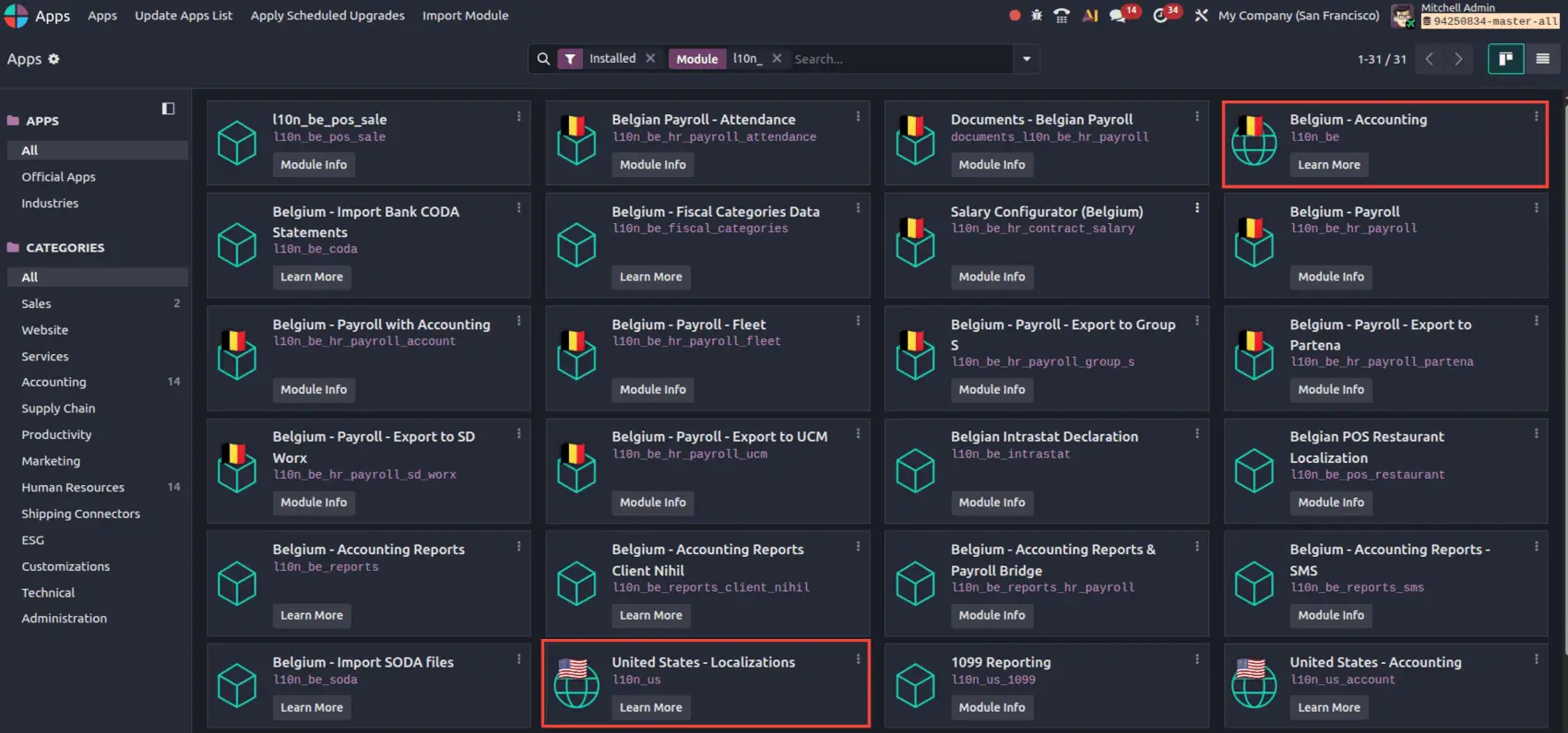
When you install account module the localization of the corresponding country code from company is automatically installed. If there is no country code, then the generic localization for US is installed.
You can find a sample of localization modules in below screenshot:
What all will get updated when we localize accounting for Odoo:
-
Local Taxes
-
Withholding Taxes
-
Chart Of Accounts
-
Financial Reports
What’s New in Odoo 19 Accounting Localization?
1. Expanded Localization Packages
Odoo 19 introduces more country-specific modules, improving coverage for regions like:
- India
- Middle East (UAE, KSA, Oman, Qatar)
- Europe (EU VAT, Intrastat improvements)
- Africa (Kenya, Nigeria, South Africa)
- LATAM (Chile, Colombia, Mexico)
Each localization pack provides ready-to-use charts of accounts, taxes, document templates, and compliance reports.
2. Smarter Tax Engine
Odoo 19 includes a more powerful tax logic system:
- Automated tax mapping based on product categories
- Reverse-charge rules for import/export
- Region-dependent VAT calculations
- Enhanced withholding tax engine
This reduces manual entries and helps ensure compliance across sectors.
3. Digital & Electronic Invoicing Improvements
Now, nations where e-invoicing is required gain from:
- Standardised formats (ZATCA for Saudi Arabia, Peppol, Fatoora, IRP/QR Code for India)
- Automated creation of invoices with QR codes
- Validation in real time using government APIs (depending on the country)
- Cross-border billing is made easier and more compliant with Odoo 19.
4. Localization-Driven Reports
Odoo 19 provides enhanced local financial reports, including:
- P&L and balance sheet in the required formats
- GSTR-1 and GSTR-3B for India
- Report on EU VAT
- Standard Audit File for Taxation, or SAFT
- EC & Intrastat Sales Lists
- Statements of withholding taxes
- VAT returns specific to a country
Better grouping, quicker rendering, and XLSX/PDF export are all features of the redesigned reports.
5. Improved Bank Sync & Local Payment Standards
These days, localisation also applies to banking:
- SEPA for Europe (direct debits, credit transfers)
- Validations of local IBANs
- Formats for bank statements specific to a nation
- Payment gateways that comply with local regulations
- Enhancements to online bank integration (where supported)
6. Localization-Ready Document Layouts
Odoo 19 comes with organised bill and invoice templates that show:
- Country-specific legal requirements
- Required tax breakdowns
- QR codes for online billing
- Space for digital signatures
- Rules for sequential numbering
This expedites deployment and lessens the need for customisation.
7. Faster Onboarding With Preconfigured Data
In many areas, Odoo currently ships with:
- COA that is pre-loaded
- Tax default
- Pre-arranged journals
- Local money
- Typical financial positions
As a result, businesses can launch in a matter of hours rather than days.
How Odoo 19 Benefits Multi-Country Enterprises
Businesses with operations in several countries often face different financial rules.Odoo19 can be used to simplify these:
It is an unified accounting platform which can be used to across regions in which the organisations can manage multiple subsidiaries with the usage of a shared dashboard and standardised workflows.
Multi currency and multi company efficiency
This helps in automatic handling of the following:
- - Exchange rate differences
- - Consolidated reporting
- - Intercompany transactions
The consistent usage will help in proper decision making and thus it helps in reducing mismatches in accounts.
Reduced Errors and Audit-Readiness
With localization-driven accuracy, financial records are always audit-ready. This is important during inspections or government reviews.
Cost Reduction
Companies save on:
- - External accounting consultants
- - Third-party verification tools
- - Manual compliance checks
- - Custom design work for reports
Odoo 19 provides compliance out-of-the-box, which significantly lowers operational costs.
Why Odoo 19 Localization Matters More Than Ever
Because, In the present world the Tax authorities majorly depend upon the digital sector, the businesses should also be updated inorder to avoid penalties.
- - accurate tax calculations
- - compliant financial documents
- - traceable audit logs
- - secure and standardised e-invoicing
- - error-free statutory reports
To keep up with the regulatory changes, Odoo 19 will be helpful irrespective if the organisation is a startup, or multinational.
Who Should Consider Using Odoo 19 Localization?
Odoo 19 is ideal for:
- Businesses expanding globally
- Companies operating in tax-heavy industries
- Organizations with multi-country subsidiaries
- Firms needing automated VAT/GST compliance
- Businesses requiring digital invoicing
If you rely heavily on accounting accuracy and local compliance, Odoo 19 is designed for you.
Lets Conclude, Odoo 19 sets a new standard for accounting localization by providing better compliance, wider global coverage, and smarter automation features. With improved tax engines, advanced e-invoicing, and proper reporting, Odoo 19 helps businesses handle the challenges of global finance confidently.
Odoo 19 is an efficient and best option for those organisations who are in search of a unified and uninterrupted accounting service. It is smooth to use also ensure legal compliance along with efficiency. This is low cost option and can be used for those in search of long term growth.



.jpg )


Leave a comment